

About
R. Haze Hunter Conference Center, 301-557 W University Blvd, Cedar City, UT 84720, USA
https://www.suu.edu/apex/Dr. Katy Rodriguez Wimberly – Asst Professor of Astrophysics at Cal State San Bernardino
Festival of Excellence Keynote
Dr. Katy Rodriguez Wimberly is an astrophysicist, storyteller, and passionate advocate for equity in science. As an Assistant Professor at CSU San Bernardino, she studies the faintest and most ancient galaxies orbiting the Milky Way — tiny cosmic fossils that hold clues to the origins of the Universe.
Her journey to the stars has been anything but ordinary. Before becoming a scientist, Katy pursued acting, played saxophone in the Army Reserves, and worked as a Disneyland performer — all while attending community college. Inspired by Star Trek’s Captain Janeway, she reignited her childhood dream of space and went on to earn her PhD in Physics from UC Irvine.
Today, Katy blends her love of astronomy with a deep commitment to mentorship and inclusion in STEM. She serves as Director of Mentorship for the Cal-Bridge Program and Vice President of the Astronomical Society of the Pacific. At home, her universe revolves around her husband and two daughters — her favorite adventure partners for hikes and giggles. Music still fills her life, and yes — Disneyland remains a beloved escape.
Video and Podcast
Event Summary
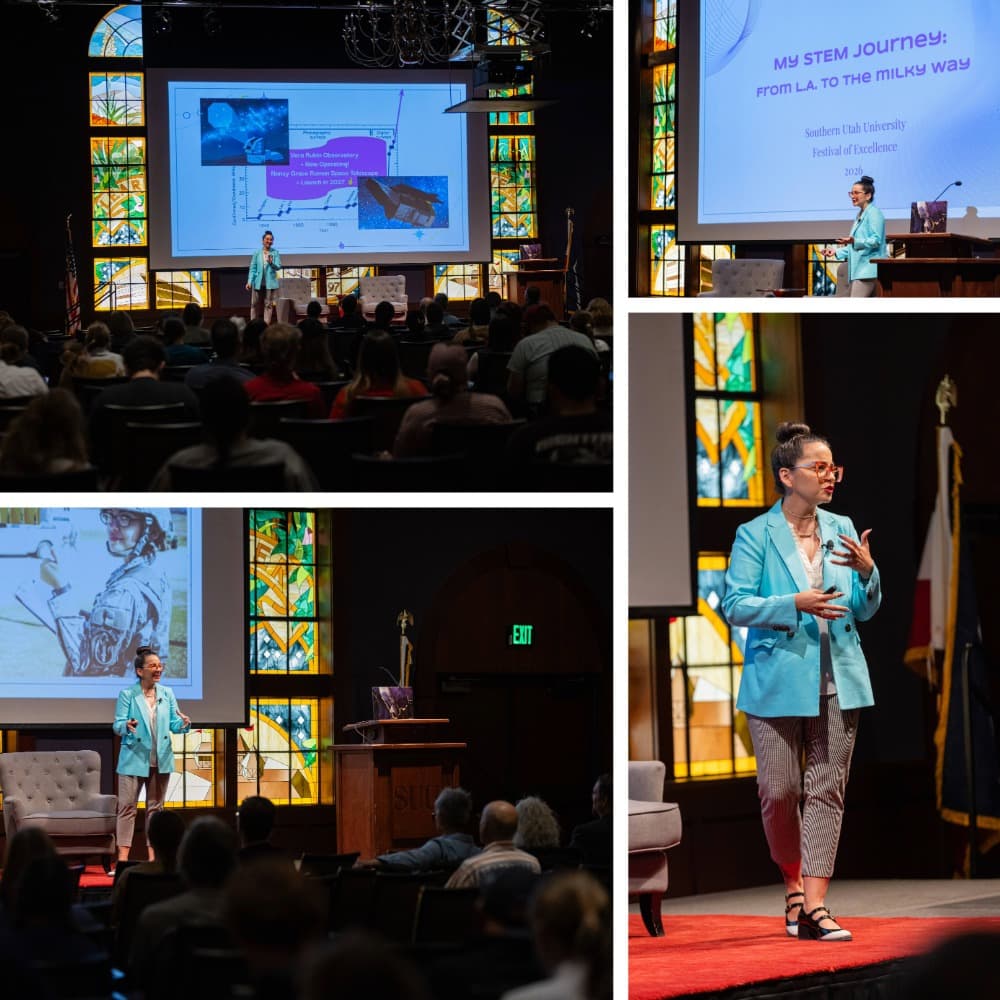
A.P.E.X. Event: My STEM Journey from LA to the Milky Way
By: Elena Moreno
The Festival of Excellence keynote featured Dr. Katy Rodriguez Wimberly, an astrophysicist who shared her personal journey into STEM and her current scientific research. She began by discussing her childhood in Los Angeles, growing up in a large family and sometimes feeling like “nobody” among so many people and possibilities. She connected this experience to the challenge of discovering who you are and what you want to pursue in life.
Rodriguez Wimberly explained that her career path was far from linear. Although she enjoyed camping in Joshua Tree and looking at the stars as a child, she did not initially realize astronomy could become a career. A teacher helped spark her interest in mathematics by describing calculus as a tool for solving puzzles. She later explored acting, played saxophone in the Army Reserve band, attended community college, and worked at Disneyland before deciding to pursue science professionally.
A turning point came while watching Star Trek: Voyager. Inspired by Captain Janeway, she began exploring astronomy and learned that studying physics could lead to a career in the field. After transferring to Cal State Long Beach, she explored several scientific areas, including robotics and condensed matter physics, before discovering her passion for astronomy.
She also explained her research on ultra-faint dwarf galaxies, which orbit the Milky Way and may be among the oldest galaxies in the universe. By studying their stars, she investigates the early universe and the stellar explosions responsible for creating different elements. She described this work as “cosmic archaeology.”
Rodriguez Wimberly discussed how telescopes, computer simulations, and sky surveys help astronomers study these distant objects. She also emphasized the importance of mentorship, family, and community in scientific careers.
She concluded by encouraging students to remain curious, explore different opportunities, and ask questions. Her message was that success in STEM does not require following a single path, but instead involves persistence, support, and discovering what inspires you.